Subatomic Computing · Quantum Validation & Materials

Quantum Circuit Validation, Execution, and Process-Level Material Models.

We validate quantum circuits, we run quantum circuits, and we develop unique lineage-connected material science datasets with continuous trajectories. By simulating manufacturing processes at the quantum level, we deliver actionable models and recipes for permanent magnet manufacturers — with additional industrial sectors soon to follow.

“Flat benchmarks ask you to infer motion between disconnected snapshots. Our architecture emerges connected microstates where every frame is the direct, validated downstream evolution of the last.”

IQ Intel — Subatomic Computing (SaC) Architecture
Live Trajectory Playback: Connected 10×10×10 quantum lattice evolution through field anneal and phase transitions, tracking up to 19 concurrent observables per microstate frame.
What We Do

From Quantum State Verification to Industrial Manufacturing Recipes.

IQ Intel bridges quantum computation and industrial materials engineering through a single, unified validation and state-evolution architecture.

01 / Verification

Quantum IV&V

Independent Verification & Validation (“Quantum Referee”) of quantum circuits, hardware outputs, optimization routines, and error-mitigation workflows against state-level reference architectures.

  • State-level fidelity checks beyond scalar energy readouts
  • Four-tier gating, falsifiability, and null-control grading
  • Independent audit without requiring proprietary circuit disclosure
02 / Execution

Quantum Circuit Runs

High-precision execution and cross-family convergence testing across six distinct quantum circuit families generated from a unified underlying Hamiltonian architecture.

  • Ballistic transport, QAOA, VQE, Hubbard JW, TFIM Anneal & Dynavector
  • 16-to-19 observables tracked simultaneously per microstate
  • 80/80 cross-check agreement across transition windows
03 / Manufacturing Models

NdFeB Model & Magnet Recipes

Quantum-level simulation of the complete permanent magnet manufacturing chain — from green-compact powder and sintering to cooling and field anneal — to optimize thermal profiles and compositions.

  • 711-frame connected trajectory across manufacturing stages
  • Curie-temperature (Tc) crossing & critical scaling (β ≈ 0.42)
  • Actionable process models for magnet producers (more sectors soon)
Service Pillar Core Scope Validation & Technical Standard Primary Deliverable
Quantum IV&V Independent verification of quantum circuits, hardware runs, and error-mitigation pipelines Tier A–D Gating, Falsifiability Null Controls, Algebraic Recompute Integrity Audit Report, Pass/Fail Gate Matrix & Trajectory Diagnostics
Quantum Circuit Runs Multi-family circuit execution & connected microstate seam generation 6-Family Cross-Validation (80/80 checks passing across 16 transition rungs) Lineage-Connected Microstate Trajectories & 19-Observable Frame Catalogs
NdFeB Magnet Recipe Service Quantum simulation of powder-to-magnet thermal, doping & field-anneal stages Curie–Bloch Scaling (α ≈ 1.8, β ≈ 0.42), Easy-Axis Anisotropy & Domain Checks Stage-by-Stage Process Models, Thermal/Field Recipes & Defect Analysis
Lineage Material Datasets Reference & custom trajectories for battery cathodes (NMC811-IQ) & photo-therapeutics (RuPT-IQ) Charge/Discharge Mirror (≤ 0.004 Li fraction), Phase 1–4 Orchestrated Pipeline Interactive 3D Lattice Viewer Access, Master Seams & SQLite/JSON State Files
01 · Quantum IV&V & Refereeing

Independent Verification & Validation for Quantum Computations.

Evaluating a quantum computation by a single scalar output (such as a final energy estimate) can pass physically incorrect states. IQ Intel acts as an independent Quantum Referee — grading internal state evolution, cross-measure consistency, and physical continuity against rigorous falsifiability controls.

“A result means more when something that shouldn’t pass, doesn’t. Our design principle is shape and direction before position: a feature must exhibit the right physical character across all coupled observables before its location is even scored.”

IQ Intel Validation Principle — Falsifiability & Null Controls

What Our Quantum IV&V Audits

  • State-Level Fidelity & Continuity: Verification that sequential quantum states represent genuine downstream physical evolution rather than disconnected numerical fits.
  • Hardware & Error-Mitigation Grading: Auditing whether error-mitigation routines preserve true multi-observable correlations (such as two-point decay ξ and Bloch magnitude |⟨σ⟩|) or artificially smooth out critical phase transitions.
  • Falsifiability & Null Controls: Running orthogonal observables that have no physical mechanism to respond (e.g., antiferromagnetic staggered magnetization in a uniaxial ferromagnet, or uncoupled mobility proxies) and requiring them to fail the transition test.
  • Recompute & Algebraic Integrity: Discriminator-tested verification that published observables reproduce from raw source states within rounding tolerance, proven to catch injected errors.

The Eight Falsifiability Controls

Designed to answer the fundamental question: “How do you know you didn’t just fit the curve?”

  • Band-Restricted Analysis: Scoring runs strictly inside the expected regime window so unrelated spikes elsewhere cannot masquerade as the transition.
  • Shape Tested Before Position: Rise/fall and critical-scaling character are gated prior to positional scoring.
  • Single-Observable vs. Composite Separation: Individual measures are flagged distinctly so a composite score cannot pass on one dominant term.
  • Forward / Reverse Mirroring: Transitions must appear on both forward and reverse trajectories (e.g., lithiation and delithiation) within strict tolerance.
  • Cross-Pipeline Co-Location: Independent structural and mobility pipelines must pinpoint the same transition locations.
  • Null Control with Discriminability: Unrelated observables must fail the shape test while real proxies clear a minimum prominence bar.
  • Discriminator-Tested Recompute: Integrity checks are verified against deliberately injected faults prior to acceptance.
  • Externally Anchored Tolerance: Comparison tolerances derive from published experimental variance rather than arbitrary cutoffs.

Four-Tier Validation Architecture

Validation Tier Gate Role What It Verifies Pass / Fail Criterion
Tier A Gating Determines overall Pass / Fail Primary order-parameter shape, critical-scaling exponent (β), transition window turnover, and forward/reverse trajectory mirror Mandatory Pass — shapes and transition directions must match physical regime rules
Tier B Consistency & Nulls Falsifiability & Discriminability Secondary order-sensitive measures (|⟨σ⟩|, fdom, coherence proxy) track primary order; null controls (⟨σx⟩, ⟨σy⟩, staggered M) do not Coupled measures must co-move; null controls must remain flat / fail transition test
Tier C Algebraic Integrity Internal Recompute Coherence Exact arithmetic relationships between raw bitstrings/states and derived observables (e.g., ⟨σz⟩ = 1 − 2 × z↓ fraction) 100% frame-by-frame reproduction within numerical rounding tolerance
Tier D Informational Secondary Diagnostics Correlation length (ξ), energy surrogate derivative (d⟨H⟩/dT specific-heat anomaly), defect radius, compaction variance, and axis audits Reported for physical context and anomaly co-location (non-gating)
02 · Quantum Circuit Execution

Multi-Family Quantum Circuit Runs & Cross-Method Convergence.

A physical result that depends on the specific quantum algorithm used to compute it is a fragile result. We execute quantum circuits across six distinct circuit families generated from a single underlying architecture — proving that 16 to 19 coupled material properties move collectively through the exact same physical transition.

6 from 1 Quantum circuit families generated from one architecture
16 / 16 Transition rungs covered (ΔLi = 0.01, 15–35% SOC)
80 / 80 Cross-family checks passing against seam backbone
16–19 Simultaneous physical observables resolved per frame

“This is not 2 or 3 properties following a fitted line — it is 16 to 19 quantum observables moving collectively along the trajectory, with all 6 quantum circuit families independently confirming the same phase transition.”

Cross-Family Convergence Standard

Six Quantum Circuit Families Executed & Cross-Validated

Circuit Family Architecture Role Physical Formulation Cross-Validation Result
1. Ballistic Transport Master Seam Backbone Continuous state-evolution seam tracking transport, domain formation, and phase boundaries across full operating range Primary reference trajectory (100% continuity validated)
2. QAOA Combinatorial / Variational Cross-Check Quantum Approximate Optimization Ansatz parameterized from the same underlying Hamiltonian rung states 16 / 16 rungs agree with backbone transition onset & direction
3. VQE Ground / Low-Excited State Cross-Check Variational Quantum Eigensolver circuit family evaluating energy-band and order-parameter landscapes 16 / 16 rungs agree with backbone transition onset & direction
4. Hubbard JW Fermionic Lattice Mapping Jordan–Wigner transformed Hubbard Hamiltonian circuits capturing strongly correlated site occupancy and spin 16 / 16 rungs agree with backbone transition onset & direction
5. TFIM Anneal Ising Spin-Exchange Schedule Transverse-Field Ising Model annealing schedule probing uniaxial spin alignment and critical scaling 16 / 16 rungs agree with backbone transition onset & direction
6. Ballistic Dynavector Dynamic State-Vector Evolution Alternative dynamical propagator verifying that trajectory evolution is invariant to circuit compilation family 16 / 16 rungs agree with backbone transition onset & direction

Emergent vs. Enumerated Simulation

Conventional material simulations require researchers to enumerate atomic configurations in advance and calculate static properties for each guess. IQ Intel’s Subatomic Computing (SaC) engine instead emerges quantum microstates directly from the modeled Hamiltonian:

  • Connected Microstate Lineage: Each state is evolved from its predecessor under physical continuity constraints, preserving path memory and hysteresis.
  • Full Bitstring & Field Readout: Every frame records Z-basis bitstrings, Bloch vectors (⟨σx⟩, ⟨σy⟩, ⟨σz⟩), two-point spatial correlators (Δr = 1…6), polaron/defect radii, and coherence proxies.
  • Custom Circuit Runs for Partners: We configure and execute multi-family circuit sweeps tailored to your target material lattice, doping profile, or quantum hardware benchmark.
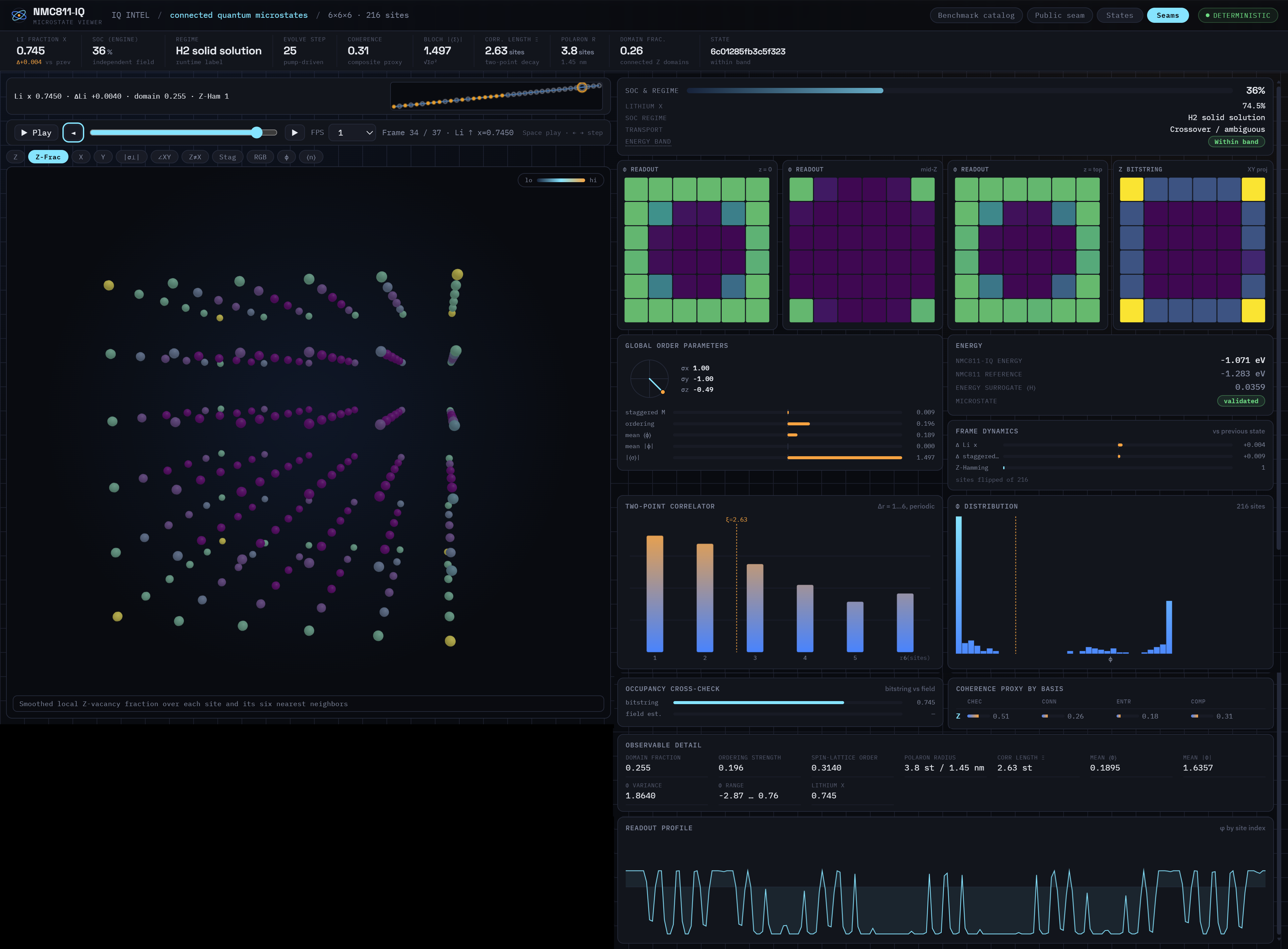
IQ Intel Microstate Viewer showing 6x6x6 lattice, Z-bitstring readouts, two-point correlator, and 19 observables.
IQ Intel Microstate Dashboard: Simultaneous inspection of 3D lattice sites, planar Z-readouts, global order parameters, two-point correlation decay (ξ = 2.63), and occupancy cross-checks.
03 · NdFeB Model & Magnet Recipe Service

Quantum-Level Manufacturing Simulation for Permanent Magnets.

Through our MagNet-IQ platform, we simulate the industrial Nd2Fe14B manufacturing process at the quantum microstate level — tracking continuous state evolution from initial green-compact powder through preheat, high-temperature sintering, cooling across the Curie temperature (Tc), and finishing field anneal.

“Rather than treating manufacturing stages as isolated black boxes, we model the continuous 711-frame quantum microstate pathway from powder to finished magnet — giving magnet manufacturers a physics-validated testbed to optimize thermal ramps, cobalt/heavy-rare-earth doping recipes, and annealing schedules.”

MagNet-IQ — NdFeB Process & Recipe Modeling
For Magnet Manufacturers

What Our Magnet Recipe & Model Service Delivers

  • Thermal Ramp & Sintering Optimization: Evaluate how preheat degassing holds (~340–380°C) and multi-step sintering ramps (~1010–1040°C) drive disordering and residual lattice correlations before cooling.
  • Doping & Composition Tuning: Model the impact of Cobalt substitution (which shifts Tc upward by ~11°C per at% Co) and grain-boundary additions on order-parameter reemergence without costly trial-and-error furnace runs.
  • Cooling & Field-Anneal Recipe Design: Track critical-scaling reemergence (β ≈ 0.42, 3D-Ising uniaxial class) and sub-Tc domain alignment across frames 445–711 to maximize domain fraction (fdom → 1) and minimize magnetic defect radius.
  • Stage-to-Stage Path Memory Analysis: Identify how upstream powder compaction variance (Var(|σz,i|)) and defect seeding propagate into downstream annealed states.
Commercial Context & Physics Baseline

Grounded in Nd2Fe14B Literature & Industrial Targets

Every process stage is anchored against established Nd2Fe14B Curie temperature baselines (Tc ≈ 310–330°C / 580–602 K for undoped compositions; up to ~342°C for Co-substituted recipes) and commercial sintered magnet performance context:

  • Order Parameter Scaling: Matches atomistic spin-model Curie–Bloch form m(T) = [1 − (T/Tc)α]β with α ≈ 1.80 and β ≈ 0.418 (capturing sharp 3D-Ising uniaxial c-axis anisotropy rather than flat β = 0.5 mean-field).
  • Specific-Heat & Correlation Signatures: Frame-to-frame energy surrogate derivative (Δ⟨H⟩ / Δstep) exhibits a co-located peak at Tc alongside correlation length (ξ) growth.
  • Commercial Target Context: Supports engineering workflows targeting high-coercivity sintered benchmarks (Hci ≈ 36.3 kOe, Br ≈ 11.7 kGs, BHmax ≈ 34.0 MGOe; single-crystal ceiling ~59 MGOe).

NdFeB Manufacturing Process Trajectory — Stage-by-Stage Model

Process Stage Industrial Temp. Target Position vs. Tc (~315°C) Primary Order (Mean |φ| / ⟨σz⟩) Secondary & Diagnostic Behavior Seam Availability
P-Series (P0–P2)
Powder Formation & Milling
Ambient / Mechanical Milling Below Tc Initial green-compact ordered baseline established Structural/compositional initialization; baseline compaction variance ρ Public Seam (444 frames)
Stage A — Preheat
H2 Degassing Hold
~340–380°C At / Just Above Tc Onset of disordering — controlled partial decrease from baseline (not full collapse) Bloch magnitude |⟨σ⟩| tracks |φ| partial decrease; departure from coherent alignment Public Seam (444 frames)
Stage A — Heat
Sintering Ramp & Hold
Staged ramp to ~1010–1040°C
(holds at 250, 550, 750°C)
Far Above Tc Collapse toward zero — sintered body demagnetizes completely Domain fraction fdom ≈ 0.5 (random up/down split); correlation length ξ flat and short-range Public Seam (444 frames)
Stage B — Reemergence
Controlled Cooling
Cooling down through ~320°C Crossing Tc (Above → Below) Sharp critical-scaling rise following Curie–Bloch curve (α ≈ 1.8, β ≈ 0.42) fdom → 1; ξ grows & plateaus; d⟨H⟩/d(step) shows specific-heat peak; defect radius drops; null controls (⟨σx⟩, ⟨σy⟩, staggered M) stay flat Public Seam (444 frames)
Finishing & Field Anneal
Post-Reemergence Alignment
Sub-Tc Anneal & Magnetic Field Lock Well Below Tc (400–500 K) High-order stabilization, domain wall pinning & recipe lock-in Captures sub-Tc domain-reorientation dynamics and final compaction homogeneity across frames 445–711 Partner Access (711 frames)

What MagNet-IQ Claims & Verifies

  • Primary order-parameter direction (Mean |φ| / ⟨σz⟩) through every process stage relative to Nd2Fe14B Tc.
  • Critical-scaling reemergence curve shape (β ≈ 0.42, 3D-Ising uniaxial character) during cooling across Tc.
  • Cross-measure consistency across |⟨σ⟩|, domain fraction fdom, coherence proxy, correlation length ξ, and magnetic defect radius.
  • Strict falsifiability via antiferromagnetic (staggered M) and transverse (⟨σx⟩, ⟨σy⟩) null controls.

Explicit Scientific Boundaries (Not Claimed)

  • Direct single-lattice derivation of extrinsic microstructure-dependent properties (Hci, Br, BHmax depend on grain-boundary phases and are used as engineering context).
  • Cryogenic spin-reorientation transition (~135 K / −138°C), which sits outside the industrial manufacturing temperature range.
  • Open public download of post-reemergence finishing stages (frames 445–711 are reserved for partner engagements).
04 · Lineage-Connected Datasets

Three Material Domains. One Trajectory-Resolved Architecture.

We develop unique lineage-connected material science datasets where every microstate carries its complete upstream history. While our commercial recipe service currently focuses on permanent magnet manufacturers, our benchmark catalog proves the same engine across battery cathodes and photo-active therapeutics — with additional industrial models soon to follow.

Dataset / Model Line Material Domain Trajectory Scope & Lattice Observables & Validation Highlights Documentation & Status
MagNet-IQ
NdFeB Permanent Magnets
Sintered Nd2Fe14B Manufacturing Chain 711 connected microstates (P0 powder → sintering → field anneal) on 6×6×6 lattice 14 numeric measures + regime classifier; Curie–Bloch β ≈ 0.42 scaling; easy-axis & Néel null controls Active Service & Dataset
Validation Protocol (PDF) →
NMC811-IQ
Li-Ion Battery Cathode
LiNi0.8Mn0.1Co0.1O2 Ballistic Transport 4 complete master seams (2 lithiation, 2 delithiation) spanning 1–99% SOC (6×6×6 & 10×10×10) Up to 19 observables per frame; 6-circuit-family convergence on H1→H2 turnover; charge/discharge mirror within 0.004 Li fraction Reference Benchmark
Validation Reference (PDF) →
RuPT-IQ
Photodynamic Therapy
Ru(II) Polypyridyl Photosensitizer Stratified 6×6×6 Hubbard + Spin-Orbit Coupling (SOC) photoexcitation mapping Targets Metal-to-Ligand Charge Transfer (MLCT), intersystem crossing (ISC), and ~520 nm activation window Pilot Stage
Available on request after convergence

Path Dependence & Hysteresis at Quantum Resolution

Because our datasets preserve continuous state-to-state lineage rather than sampling isolated equilibrium points, they expose microscopic path dependence at identical macroscopic states of charge or temperature:

  • Convergent Microstates: Identical or near-identical spin and occupancy configurations appearing across both forward and reverse trajectories.
  • Divergent (History-Locked) Microstates: Distinct metastable configurations reachable only through specific charge directions or thermal furnace histories — directly informing hysteresis, voltage fade, and magnetic domain memory.
  • Protected Distribution Policy: Validation protocols and methodology are published openly; raw microstate SQLite/JSON trajectories are released to verified partners to prevent uncompensated AI model scraping.
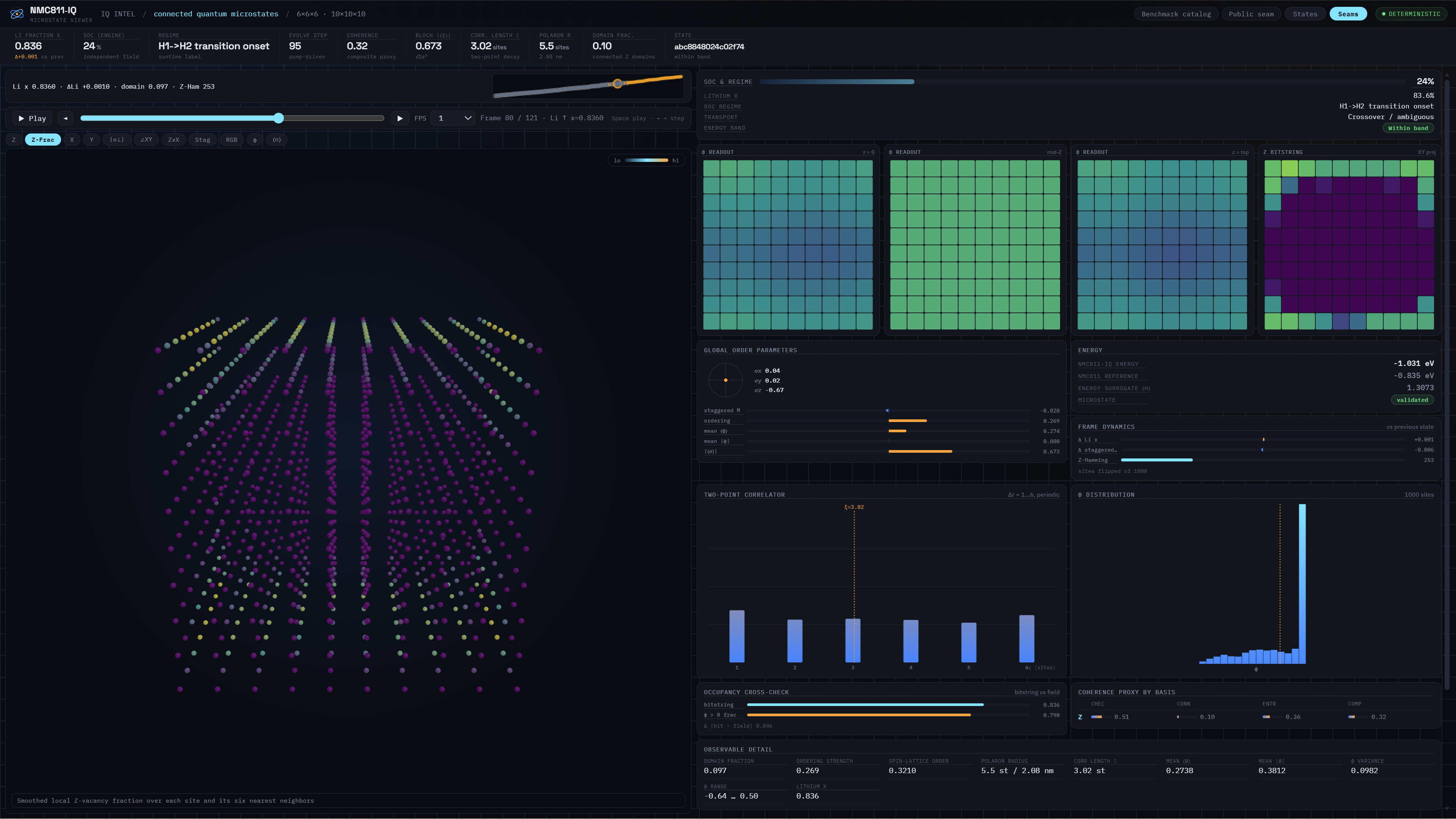
10x10x10 lattice microstate viewer at 24% SOC entering H1 to H2 transition onset.
Scale & Resolution (10×10×10 Lattice): 1,000-site connected trajectory frame at 24% SOC (Li x = 0.836), resolving polaron radius (5.5 sites / 2.08 nm) and two-point correlation length (ξ = 3.02).
Engage With IQ Intel

Start a Conversation.

Whether you need independent Quantum IV&V, custom quantum circuit runs, NdFeB magnet process modeling, or benchmark dataset access, reach out to our team below.